Sea-Doo, Yamaha, and Kawasaki: An Honest Brand Comparison From Real Riders
Quick note before we dive in: everything in this article is based on personal opinion, general community knowledge, and firsthand experience. Every rider's situation is different — before you make any buying decision, talk to your local dealer, do your own research, and if possible, demo the ski yourself. Nobody knows your local market, your budget, and your riding style better than you do.
Walk into any marina, any boat ramp, or any PWC Facebook group and it won't take long before someone starts an argument about brands. Sea-Doo riders swear by the tech. Yamaha owners talk about their engines like they're family heirlooms. Kawasaki guys just quietly do their thing and let the machine speak for itself.
Everyone has an opinion. But what do the numbers, the mechanics, and the real-world ownership experience actually say?
We broke it down across six categories that matter most to everyday riders — not just spec sheet warriors.
1. Build quality and durability
Yamaha is the gold standard here and has been for decades. Their naturally aspirated engines are engineered with conservative tolerances, meaning they're built to run well below their limits for a very long time. Yamaha WaveRunners regularly rack up 300, 400, even 500 hours with nothing more than routine maintenance. If longevity is your top priority, this is your brand.
Kawasaki is underrated in this department. Their hulls are thick and well-constructed, and the STX platform in particular has a reputation for being nearly bulletproof with proper care. Kawasaki doesn't cut corners on materials, even on their more affordable models.
Sea-Doo builds quality machines, but their complexity works against them in raw durability comparisons. More moving parts, more electronics, and supercharged engines that require scheduled rebuilds mean there's more to stay on top of. A well-maintained Sea-Doo lasts just as long as the competition — but the emphasis is on "well-maintained."
Winner: Yamaha, with Kawasaki a close second.
2. Technology and features
This isn't even close — Sea-Doo wins by a wide margin and has for years.
Intelligent Brake and Reverse (iBR), the LinQ accessory system, the Ride platform, for a drier and more stable experience, customizable riding modes, electronic power steering on select models — Sea-Doo consistently brings features to market that the other brands take years to match, if they match them at all.
Yamaha has made strides with their RiDE dual throttle system (which functions similarly to iBR) and their more recent models are more tech-forward than older ones. But they still play catch-up to Sea-Doo in this category.
Kawasaki is the most traditional of the three. They focus on the fundamentals — power, handling, and reliability — and don't chase feature lists. That's fine if you don't care about bells and whistles, but if you do, Kawasaki isn't your brand.
Winner: Sea-Doo, and it's not particularly close.
3. Performance
Sea-Doo's supercharged lineup — the RXP-X 325 and RXT-X 300 — represents the absolute cutting edge of production PWC performance. The RXP-X in particular is widely regarded as the fastest and most capable closed-course performance ski you can buy stock.
Kawasaki punches above its weight here. The Ultra 310R is a legitimate performance machine with a 310-horsepower supercharged engine that competes directly with Sea-Doo's top performers — often at a lower price point. Kawasaki's performance-per-dollar ratio at the top end is excellent.
Yamaha's FX HO and FZR/FZS models are strong performers, but the naturally aspirated FX platform tops out below the supercharged competition. If outright speed is what you're after, Yamaha's ceiling is lower than the other two.
Winner: Sea-Doo at the very top, Kawasaki for best performance value.
4. Value for money
Kawasaki wins this category, especially on the new ski side. The STX 160 consistently delivers more ski for less money than comparable Sea-Doo and Yamaha models. If you're working with a tight budget and want a brand new three-passenger ski, Kawasaki deserves a serious look before you make a decision.
Sea-Doo's Spark is the exception — it's the most affordable new PWC on the market at under $8,000, and it's a genuinely fun machine. Outside of the Spark though, Sea-Doo's pricing reflects their technology premium.
Yamaha tends to be the most expensive brand at the entry and mid levels relative to features offered. You're paying for the reputation and resale value, which is a legitimate reason — but it does mean a higher upfront cost.
Winner: Kawasaki overall, Sea-Doo Spark for entry-level specifically.
5. Resale value
Yamaha holds its value better than either competitor, consistently. A well-maintained 5-year-old WaveRunner will command more on the used market than an equivalent Sea-Doo or Kawasaki of the same age and hours. This matters a lot if you plan to sell or upgrade down the road.
Sea-Doo holds value reasonably well, especially performance models. The rapid pace of new model releases does work against older Sea-Doos — last year's tech can feel dated quickly in a brand that updates frequently.
Kawasaki has the weakest resale of the three, partly due to lower brand recognition among casual buyers and a thinner dealer network. This is also why used Kawasakis can be great deals if you're buying — the depreciation has already happened.
Winner: Yamaha.
6. Dealer network and parts availability
Sea-Doo and Yamaha are neck and neck here. Both have extensive dealer networks across the country, and parts for both are widely stocked. If something goes wrong mid-season, finding a dealer or ordering a part is rarely a problem with either brand.
Kawasaki lags noticeably behind. Fewer dealers, less parts inventory at local shops, and longer wait times for specialty components. In major metro areas this is less of an issue, but in rural parts of the country it can be a real inconvenience.
Winner: Sea-Doo and Yamaha (tied).
The bottom line
There is no objectively best brand — but there is a best brand for you depending on what you care about most.
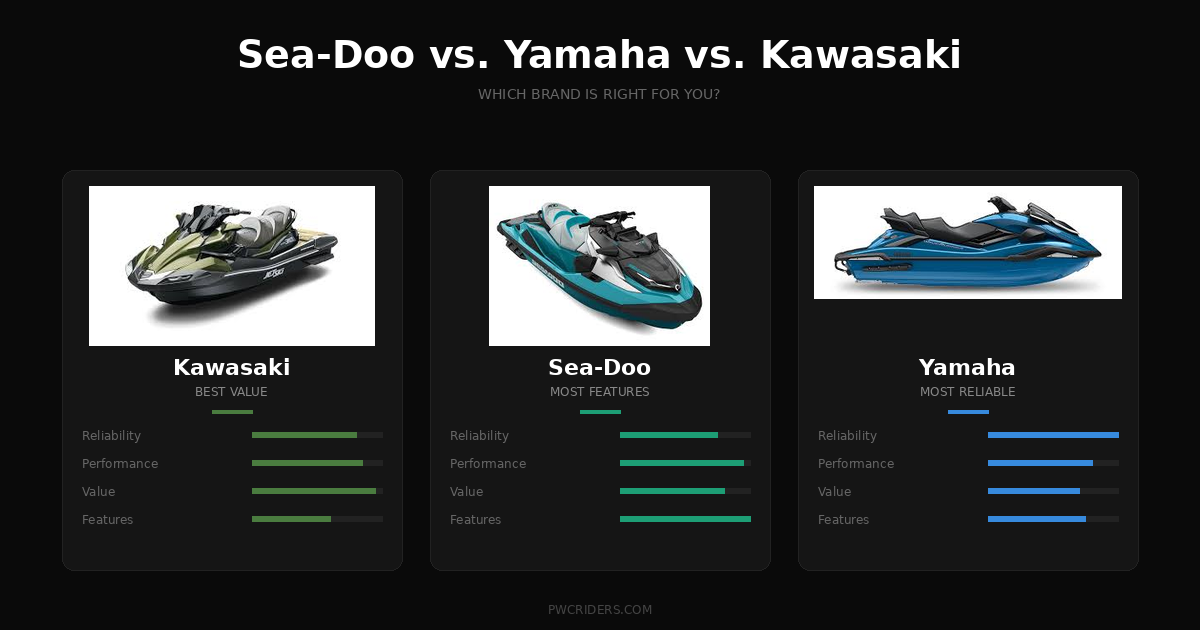
If you want the most features, the best performance, and the widest selection of models, Sea-Doo is your answer. If you want the most reliable machine, the best resale value, and the lowest long-term ownership stress, Yamaha is your answer. If you want the most ski for your money and don't need the biggest dealer network, Kawasaki is worth a serious look.
The best advice? Decide which two or three things matter most to you — budget, reliability, performance, features — and let that narrow the field. Then find the best-condition ski in that category at the best price. Brand loyalty is great, but a well-maintained machine beats a neglected one every single time regardless of the badge on the hull.
If you enjoyed this article, be sure to sign up for our newsletter for more content weekly!
Disclaimer: The opinions expressed in this article are personal and based on general community knowledge and experience. Always consult your local dealership, do your own research, and if possible test ride before you buy. Prices, model availability, and dealer networks vary by region and change over time — verify current details with your dealer before making any purchasing decisions.